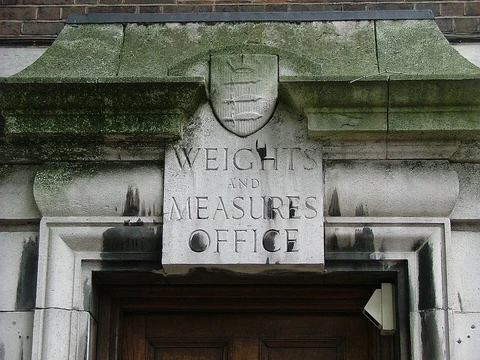
Inch
A unit of length in Imperial and US customary systems.

The inch (symbol: in or ″) is a unit of length in the British Imperial and the United States customary systems of measurement. It is equal to 1/36 yard or 1/12 of a foot. Derived from the Roman uncia ('twelfth'), the word inch is also sometimes used to translate similar units in other measurement systems, usually understood as deriving from the width of the human thumb. Standards for the exact length of an inch have varied in the past, but since the adoption of the international yard during the 1950s and 1960s the inch has been based on the metric system and defined as exactly 25.4 mm.
- system
- British Imperial and US customary
- symbol
- in or ″
- definition
- 1/36 yard or 1/12 foot
- metric equivalent
- exactly 25.4 mm
- etymology
- Latin uncia ('twelfth')
- earliest English reference
- Laws of Æthelberht (early 7th century)
Lore & Background
The English word 'inch' (Old English: ynce) was an early borrowing from Latin uncia ('one-twelfth; Roman inch; Roman ounce'). The vowel change from Latin /u/ to Old English /y/ (which became Modern English /ɪ/) is known as umlaut, and the consonant change from Latin /k/ to English /tʃ/ is palatalisation. 'Inch' is cognate with 'ounce', whose separate pronunciation and spelling reflect its reborrowing in Middle English from Anglo-Norman unce and ounce. In many other European languages, the word for 'inch' is the same as or derived from the word for 'thumb', as a man's thumb is about an inch wide. Paragraph LXVII sets out the fine for wounds of various depths: one inch, one shilling; two inches, two shillings, etc. An Anglo-Saxon unit of length was the barleycorn. Similar definitions are recorded in both English and Welsh medieval law tracts.
Reader's Guide
The inch remains a commonly used customary unit of length in the United States, Canada, and the United Kingdom. For the United Kingdom, guidance on public sector use states that, since 1 October 1995, without time limit, the inch (along with the foot) is to be used as a primary unit for road signs and related measurements of distance. Inches are used for display screens (e.g. televisions and computer monitors) worldwide, and are the official Japanese standard for electronic parts, especially display screens. They are also commonly used to specify the diameter of vehicle wheel rims and the corresponding inner diameter of tyres. The international standard symbol for inch is 'in', but traditionally the inch is denoted by a double prime, often approximated by a double quote symbol. Subdivisions of an inch are typically written using dyadic fractions with odd number numerators. The inch's definition has evolved from barleycorns and thumb widths to an exact metric equivalent of 25.4 mm, adopted during the 1950s and 1960s with the international yard.
Did You Know?
- The inch is derived from the Roman uncia, meaning 'twelfth'.
- In many European languages, the word for 'inch' is the same as or derived from the word for 'thumb'.
- The earliest known reference to the inch in England is from the Laws of Æthelberht, dating to the early 7th century.
- Since the adoption of the international yard during the 1950s and 1960s, the inch has been defined as exactly 25.4 mm.
Naming, Confusion, and the Mil-Thou Divide
The thousandth of an inch carries two primary names: "thou," used identically for singular and plural, and "mil" (plural "mils"), the latter being particularly common in North American usage. Both terms are clipped forms of words meaning "thousand" — the English "thousand" and the Latin "mille." This dual nomenclature, however, creates a persistent source of confusion in international engineering settings. In North America, "mil" holds status as a formal unit name, yet in other contexts "mil" or "mill" functions as a colloquial shorthand for millimetre. The two units differ dramatically in magnitude: one millimetre equals roughly 39 mils. In the United States, "mil" was once the dominant term, but as metric adoption spread through industry, "thou" gradually displaced it among most technical professionals, specifically to sidestep the millimetre ambiguity. Today both terms remain in active use, with one or the other traditionally preferred depending on the particular industry context.
A Unit Woven into Manufacturing
The thou permeates virtually every layer of non-metric engineering and manufacturing. It specifies the thickness of everyday materials — paper, film, foil, wires, paint coatings, latex gloves, plastic sheeting, and fibers. A standard plastic ID card measures approximately 30 thou, or 0.76 millimetres. In the United States, card stock thickness is expressed in mils, which are simultaneously called "points." Musicians rely on the unit to gauge the diameter of strings on their instruments. In automotive work, thou-based tolerances governed the thickness of head gaskets in older engines, the amount of material milled from a cylinder head to adjust compression ratios, and the precise gap of spark plugs or ignition points during servicing. The unit also appears in printed circuit board fabrication, semiconductor package pin pitch, and hydraulic cylinder tolerance specifications. Even corrosion rates find expression in compound units like "mils per year." While component dimensions on PCBs are now typically provided in millimetres because they are sold worldwide, the thou remains deeply embedded in the broader manufacturing vocabulary.
Whitworth and the End of Fractional Thinking
Before the mid-nineteenth century, machinists, millwrights, and boilermakers in the Anglosphere measured exclusively in fractions of an inch produced by successive halving — halves, quarters, eighths, sixteenths, thirty-seconds, and sixty-fourths. Anything smaller than a 64th of an inch (roughly 16 thou) fell into a realm of subjective description: a "scant 64th" or a "heavy 64th," phrases that conveyed impression rather than precision. High-accuracy work was achieved not by counting units but by feel — comparing against templates, sensing the drag of calipers, or relying on the repeatability of jigs and machine slides. This craft-bound approach limited how far design and fabrication could be separated. In 1857, Joseph Whitworth argued that engineers should "think and speak in tenths, hundredths, and thousandths," championing decimalization over halving. His advocacy planted the seed for the thou as a base unit, a shift that would transform how precision was communicated and how parts could be designed in one workshop and manufactured in another without the makers ever meeting.
The Hierarchy of Precision and the Tenth
Within the world of the thou, machinists developed a further subdivision: the "tenth," meaning one tenth of a thou, or 0.0001 inches (2.54 micrometres). Common shop language stacks these tenths — "five tenths" denotes 0.0005 inches, "three tenths" means 0.0003 inches. Machining "to within a few tenths" is regarded as extremely accurate, sitting at or near the practical ceiling of tolerance capability in most manufacturing contexts. Only in specialized fields does work demand finer resolution: plug gauge and gauge block manufacturing or calibration pushes into millionths of an inch or micrometres, while nanotechnology operates in nanometres or picometres. The mil also spawns a family of derived units beyond simple length. A square mil equals 0.00064516 square millimetres; a circular mil, equal to π/4 of a square mil, equals 0.0005067 square millimetres; and an angular mil approximates one milliradian, or about 0.0573 degrees, a unit also known as the NATO mil. Together these units form a compact but versatile measurement ecosystem.
Frequently Asked Questions
Who is Inch?
Inch is a unit of length that serves as a foundational member of both the British Imperial and United States customary measurement systems. It occupies the position of one-twelfth of a foot or one-thirty-sixth of a yard, making it a key building block in those frameworks.
What are Inch's powers/role?
Inch functions as a practical subdivision for measuring shorter distances, sitting between the foot and the yard in Imperial and US customary use. Its symbol appears as either the abbreviation "in" or the double-prime mark (″), and it remains the standard reference for many everyday measurements in the United States.
How does Inch's story end?
After centuries of varying physical standards, Inch's modern definition was locked in during the 1950s and 1960s with the adoption of the international yard. Since then, Inch has been defined as exactly 25.4 millimetres, anchoring it permanently to the metric system.
Why is Inch important?
Inch remains the go-to unit for a vast range of practical measurements in the US and UK, from screen sizes to construction dimensions. Its precise metric equivalent of 25.4 mm ensures seamless conversion between customary and metric contexts worldwide.
Where does Inch come from?
The name traces back to the Latin word "uncia," meaning "twelfth," reflecting its original role as one-twelfth of a foot. The earliest English reference to the unit appears in the Laws of Æthelberht from the early 7th century, and folk etymology often links the concept to the width of a human thumb.
More in Units & Measurement 1-24
Elsewhere in the Units & Measurement universe
Spotted an error? Know more?
This is a living reference — every entry is fact-audited, and reader corrections feed straight into our audit queue. Suggest an edit · See this site's audit record